
In My Own Words: A Public Response on Yanomami Research, Ethics, and Recent Allegations

Updated: Apr 29
Over the past several days, questions and allegations about my work with Yanomami communities in Brazil have circulated in academic and public spaces. Because these claims concern my name, my research, and my relationships with Yanomami communities, I believe it is important to respond directly and in my own words.
The statement below clarifies my role in the Yanomami microbiome research project, the MPF inquiry concerning my 2025 visit to the Marauiá region, and the ethical commitments that guide my work. I share it publicly in the interest of transparency, accountability, and respect for the Yanomami leaders and communities whose voices must remain central to this discussion.
This statement reflects my own views and words. It is not a statement on behalf of Shabono Media LLC, its partners, collaborators, or film team.
April 27, 2026
Background
My name is David Good, known as Ayõpëwë among my Yanomami relatives, family, and friends. My shabono, or home community, is Irokaiteri, in the Upper Orinoco, where my mother and close relatives live. I am Yanomami, and Yanomami territory is my home. My relationship to this land and people is lived through kinship, ancestry, repeated visits, and relationships built across Yanomami communities in Venezuela and Brazil.
I am also a scientist. In the coming months, I expect to defend my PhD thesis in the Department of Molecular and Cellular Biology at the University of Guelph. I may be among the very few Yanomami people, and perhaps the first, to complete a doctoral degree in this field. I carry that responsibility seriously.
My ambition is to contribute meaningful research in human health while helping create a future in which Yanomami people are represented in science as researchers, decision-makers, and leaders. Too often Indigenous people are invited into academic spaces only as symbols, informants, or subjects of study. That must change.
That change must happen at many levels: in how researchers engage Yanomami communities on the ground, in how universities fund ethical collaboration, and in how Indigenous knowledge holders are recognized within academic systems as research colleagues and peers. I made this argument in a recent co-authored perspective article, Toward a Yanomami Framework for Ethical Microbiome Research. The article reflects lessons from the long history of Yanomami research, including anthropology’s contributions and failures, the shadow of the Darkness in El Dorado controversy, and my own field experience, family connection, and scientific training.
Microbiome research is still a relatively new and emerging field. For that reason, I have leaned heavily on anthropology, a discipline that has spent decades researching among the Yanomami and has also had to confront its own ethical failures. Combined with my field experience, my familial connection to the Yanomami people, and the lessons of anthropology, I joined colleagues in trying to advance a critical area of research that is deeply important not only to the Yanomami, but to the world. I do this as a Yanomami person, with the Yanomami people.
Research involving the Yanomami has a complicated history. There have been important contributions, but there have also been examples of exploitation, extraction, and profound failures of respect. Those realities are not abstract to me.
Over the years, I have come to understand that legal compliance alone does not answer the deepest ethical questions. Prior consultation, informed consent, and proper authorizations are essential, and I adhere to them. But administrative approval is only the beginning of ethical responsibility.
What is too often missing is the Yanomami ethical framework.
Do communities understand how research may be used? Do they equitably share in its benefits? Who defines benefits? Are the Yanomami authentically treated as collaborators rather than raw material for academic careers? Are young Yanomami being supported to become scientists, health professionals, and leaders in their own right?
These questions have shaped my work. They are not my questions alone. After many conversations with Yanomami leaders, I have heard them raise these same concerns.
My research focuses on the human gut microbiome, the vast community of microorganisms that live within us and play critical roles in immunity, metabolism, and health. The Yanomami people have drawn scientific attention because some communities possess extraordinary microbial diversity, offering insights into the relationship between ecology, diet, and human wellbeing.
But for me, this research also raises urgent questions about cultural change, environmental disruption, nutrition transitions, and the long-term health consequences of rapid contact with industrialized society. These are changes I have witnessed myself.
In many communities along the Marauiá River, in Brazil, I have seen traditional food systems and practices increasingly affected by outside goods: commercial tobacco, ultra-processed foods, refined sugar, white pasta, and broader exposure to biomedical interventions such as antibiotics. I am not writing this to patronize Yanomami communities or to condemn change. I am saying that these transitions have health implications, including for the microbiome, and the Yanomami have a right to understand that science.
This research also reinforces the idea that the protection of Yanomami life and the protection of the Amazon are inseparable.
Science should not arrive only to extract knowledge and leave. One of the most serious criticisms I have heard from Yanomami communities is that researchers, from any field, often come, collect what they need, and then disappear. Those who know Yanomami culture well understand how deeply this affects trust. Research must not be transactional. It must be relational.
The research process should build relationships, share opportunity, strengthen local capacity, and proceed with humility. These principles are not mine alone. They are shared by many researchers, collaborators, and Yanomami partners in Brazil and Venezuela who have worked for years to imagine more respectful forms of research. The Yanomami possess deep knowledge of the forest, food systems, ecology, and survival that no laboratory can replicate. When knowledge systems meet with mutual respect, everyone benefits.
This is the work to which I have dedicated my life.
I offer this background because much has recently been said about me and my activities in Yanomami territory in Brazil. Rumor often moves faster than truth, and partial narratives can quickly harden into public assumptions. For that reason, I believe it is necessary to speak clearly, in my own voice, and address recent accusations directly.
The Timeline of Events Leading to the MPF Inquiry
Before setting out this timeline, I want to state an important point. The microbiome research project involving communities of the Rio Marauiá region was a Brazilian-led academic project affiliated with the Federal University of ABC (UFABC). Our team entered in August 2023 with the appropriate permits and, most importantly, with authorization from Yanomami communities. I was not the Brazilian principal investigator, nor was I solely responsible for the administrative pipeline of authorizations. My role was as a scientific collaborator, a Yanomami bridge figure, and someone committed to ensuring that Yanomami voices were heard throughout the process.
The project proceeded through Brazilian institutional channels and received the relevant approvals at the time, including publication in the Diário Oficial da União. What I can speak to directly are my own actions, my own intentions, and the sequence of events that later became the subject of rumor and formal inquiry.
Before moving through the timeline, I want to address two administrative issues directly because they have been referenced publicly and could easily be misunderstood.
First, our team had previously received written favorable support from FUNAI during the broader authorization process. The dates and location of entry for the 2023 research fieldwork had been communicated through the appropriate institutional channels and were included in the authorization process documented in the Diário Oficial da União. Later, after our 2023 fieldwork had already been completed, the team received a FUNAI letter advising reconsideration of entry into Yanomami territory due to the public health emergency and concerns about respiratory illness in the territory. The timing and administrative sequence were confusing, especially because we had previously received support from FUNAI as part of the authorization process.
I cannot speak with authority on the internal administrative communications between UFABC, FUNAI, and other Brazilian agencies. Those matters were handled by the appropriate Brazilian institutional representatives. My understanding, based on what was communicated to me by the responsible parties, is that UFABC followed up with FUNAI regarding these concerns, the confusion was addressed, and the research team is continuing the analysis and will publish initial findings from the samples already collected.
Second, it is true that the CNPq authorization connected to the project was later revoked in 2025. That fact should be stated clearly. But it should also be stated accurately.
The research team and the overall project did receive official CNPq authorization in 2023 for the research project “Study of the immunomodulatory functions of the Yanomami microbiota.” That authorization included the collection of biological material, the participation of foreign researchers, and work in authorized communities in the Marauiá region of Amazonas.
Although the authorization was later revoked in 2025, a later revocation is not the same as saying the project never had authorization. Nor does it automatically mean that every action taken under the authorization before revocation was unlawful. My understanding, based on communications from the Brazilian principal investigator, is that the revocation prevented further field collection under that authorization, while allowing analysis to continue on samples already collected during the period when authorization was active.
I include these details because public discussion has sometimes collapsed very different issues into a single accusation: as if administrative confusion, later revocation, and my personal participation during a separate 2025 visit were all the same thing. They are not.
The 2023 research fieldwork coordinated by UFABC and the later administrative developments, on the one hand, and my 2025 invited community visit, on the other hand, must be understood separately.
Earlier Origins of the Project
It is important to clarify that this research initiative with the Marauiá Yanomami communities did not begin with my arrival in Brazil. The project was first introduced by Brazilian colleagues in 2018, before my formal involvement in the Marauiá research effort. At that same time, I was conducting microbiome research among Yanomami communities in the Upper Orinoco region of Venezuela.
During that earlier phase, the proposal was presented through the Kurikama Association, an important Yanomami representative organization in the Marauiá region. Under the coordination of Samuel, from the community of Curuá, leaders gathered through the Kurikama Association agreed to support the project and authorized the research team to proceed with submissions to the Brazilian authorities. Thus, the project had free, prior, and informed support from Yanomami leadership involved in that consultation process.
The COVID-19 pandemic, along with subsequent changes in government and administration, delayed progress. Because leadership within the Kurikama Association later changed, it was necessary to renew consultation rather than assume earlier approvals remained sufficient.
Renewal of Consultation and Authorization
When the project resumed, I personally attended a Kurikama Association assembly in early 2023 and presented the research directly to the leadership and representatives present. I explained the goals of the project, answered questions, and welcomed open discussion. After deliberation, the leaders present agreed to renew support for the project under the leadership of Otávio, who was then coordinator of the Kurikama Association and is from the community of Bicho Açu.
I include these details because they matter. This project did not move forward casually or in secrecy. Considerable time, travel, and resources were invested so that the research could be explained directly, concerns could be raised openly, and communities could decide for themselves whether they wished the project to proceed.
Why I Became Involved
My involvement in this work was personal and ethical.
As a Yanomami researcher pursuing a PhD in microbiome science, I believed that if research involving the Yanomami was going to occur, then Yanomami people deserved more than basic compliance. They deserved open and authentic explanation, participation, capacity-building, a pathway into science itself, and equitable benefit-sharing on their own terms.
That conviction later became part of our published framework for ethical microbiome research.
Engagement With Communities in Marauiá
Over time, I developed relationships with leaders and families in the Marauiá region through repeated visits, dialogue, and shared concern about the rapid health transitions affecting many communities as diets, lifestyles, and outside pressures continue to change.
I spoke openly with leaders about microbiome science, what samples are used for, and why the research might matter for future health. I also emphasized that participation should always be voluntary and that communities had every right to ask questions, refuse participation, or demand greater clarity.
I was also addressing one of their key ethical concerns: they do not want research to happen around them without real and meaningful opportunities to participate in it and understand it. They want to learn. The youth want to learn more about science and research. They want to play a more involved role in the research process, both in and out of the field.
I envision Yanomami representatives in the lab, culturing bacterial strains, analyzing DNA sequences, and developing novel research questions. This is the future I am working toward.
The leaders also wanted research updates and results to be directly shared with them. They wanted this research project to be relational, not transactional. In my experience, research institutions often receive informed consent from Yanomami communities, and once that box is checked, the Yanomami ethical perspective can quickly become deprioritized.
That is exactly what many of us, Yanomami leaders and research collaborators alike, are trying to change.
Continued Engagement After the Authorized Research Visit
Over time, I have developed strong relationships with various leaders in the region. I have supported community projects ranging from the construction of health clinics, including one often used by SESAI, to renewable energy systems and satellite communication for schools, clinics, and local leaders.
Some of this support has been connected to my work with the Yanomami Foundation, a nonprofit platform that helps raise resources to support Yanomami-led projects, community priorities, education, and long-term partnerships. The Foundation exists to help mobilize support for Yanomami communities. It is not a university or research institution, and it does not conduct scientific research or collect biological samples. The Brazilian microbiome research project discussed here was led through UFABC, not by the Yanomami Foundation.
I must be absolutely clear: this support was never offered, promised, or provided in exchange for biological samples, individual participation, or consent to research. It was entirely separate from sample collection. These efforts were part of a long-term commitment to kinship, social responsibility, and community-defined priorities. They were based on requests from leaders and carried out with local supporters, Yanomami leaders, and colleagues who combined resources and effort to support communities in ways defined by them.
It would be a mistake to automatically treat every form of community support as an inducement for research. Doing so risks misunderstanding the relational responsibilities that come with long-term engagement. At the same time, I understand why this issue must be handled carefully. For that reason, I have always maintained that community support must never be conditional on participation in research.
In 2025, I returned to the Marauiá region after being invited by Yanomami leaders and relatives in my capacity as a Yanomami family member. This included Mauricio of the Ixima community, who coordinated the Youth Event held at the Pukima Beira shabono. That invitation is documented.
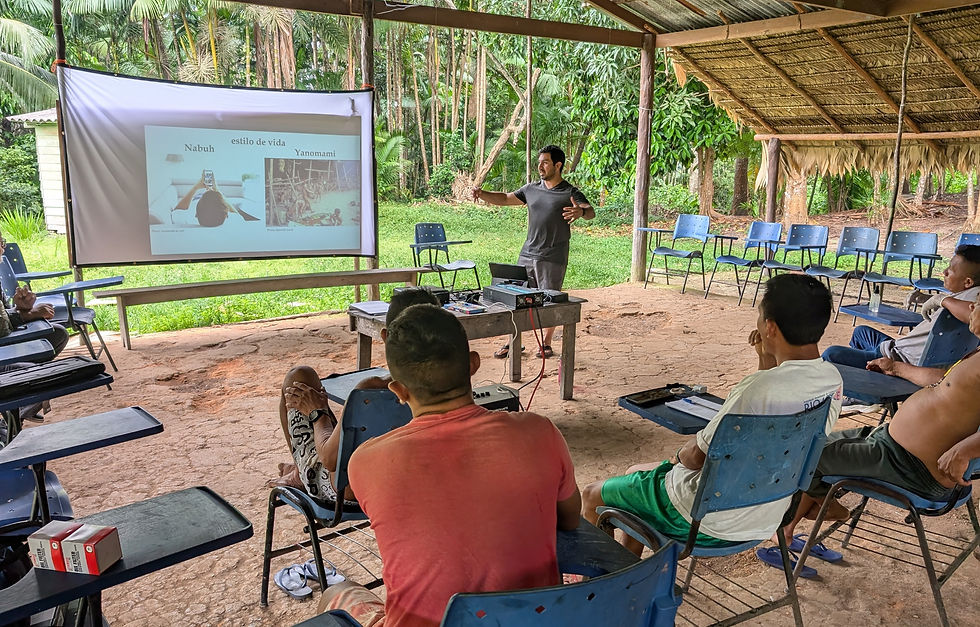
The Youth Event included the presence of other community and institutional representatives, including two FUNAI field agents, a representative of SECOYA, and the director of the Guardianship Council. During that visit, I participated by giving an educational presentation related to microbiome science and health. I answered questions and helped clarify misunderstandings. I also met with leaders from multiple communities.
I was accompanied by Roni of Tomoropiwei, the current coordinator of the Kurikama Association, who was present at the Youth Event. He also provided his support for the research project, which is documented. After the event, he personally provided transportation to several other communities and requested that I share more information about the importance of microbiome research.
Some leaders expressed enthusiasm that Yanomami youth should learn science directly, visit laboratories, and eventually become researchers themselves. Others raised concerns or asked questions, which is natural and appropriate in any serious consultation process. I was completely open and transparent about this research project. I told them this would be a long process. I also assured them that I would do everything I could, as a scientist and as a Yanomami relative, to ensure that the Yanomami ethical perspective was respected and carried forward.
Ultimately, this engagement was meaningful and successful. It showed how research should be relational, collaborative, and respectful, in ways that align with participatory approaches widely discussed in collaborative anthropology. With the support of numerous leaders and community members, all documented, my next intention was to support the submission of a permit extension or amendment through the appropriate Brazilian channels so that future engagement could proceed lawfully, transparently, and with continued Yanomami participation.
The Provenance of the Denúncia
Shortly after my 2025 trip, I was contacted by an anthropologist working within the DSEI Yanomami e Ye'kwana. This person contacted me via WhatsApp and said she had heard differing accounts from some Yanomami individuals and had concerns about the project.
Through that exchange, I came to understand that a report regarding my activities had already been written before I was contacted and before I had any meaningful opportunity to respond. This detail matters. If a report helped shape later concerns or contributed to a formal denúncia, then the report appears to have been written before I had a meaningful opportunity to clarify my involvement, explain the context, or describe the discussions that took place directly with leaders and community members in the Marauiá region.
In a remote region with limited telecommunications, many communities, and complex internal perspectives, differing accounts are not unusual. That is precisely why careful verification matters.
Nonetheless, once I was contacted, I welcomed the opportunity for dialogue. I responded respectfully and in detail. I explained that the overall research project was Brazilian-led through UFABC and that approvals had been obtained through the appropriate systems. I also shared those materials in that exchange. I also shared those materials in that exchange and explained that my own role centered on communication, relationship-building, and ensuring that Yanomami perspectives were represented.
I further explained that, separate from the 2023 research trip, I had recently participated in the Youth Event, met with leaders, and was invited by communities supportive of continued engagement.
A Serious Concern About Process
What concerns me is the process. I had never met the author of the report in person. She told me she had seen me from a distance in a Yanomami community, but she did not approach me. She did not attend the Youth Event. She was not present for the meetings I held with Yanomami leaders, nor did she witness the support, questions, concerns, and discussions that took place directly with leaders and community members in the Marauiá region.
I have never been given access to her report, so I cannot assess its full contents. Based on our exchange, however, I believe there were gaps, omissions, or misunderstandings that should have been clarified before the matter escalated further.
During that exchange, I asked her to share institutional contacts so that I could forward them to the research coordinator and help strengthen dialogue through the appropriate channels. I was not given a clear path for reviewing or responding to the report itself. I also understand that Yanomami leaders, including Roni, sought clarity about the report and its contents, but I am not aware that they were provided with a meaningful opportunity to review or respond to it.
If someone is going to make serious allegations that may trigger state action, reputational harm, or formal denunciation, basic professional fairness requires contacting the person involved, hearing their account, and checking facts before escalating matters.
That did not happen in any meaningful way. To this day, I still have not been informed which institution or office officially filed the denúncia. I cannot judge the internal procedures of Brazilian institutions. But from the standpoint of fairness, transparency, and ethical research practice, the process was deeply troubling.
In summary, a field report appears to have been shaped by incomplete information and unverified rumors, and an official denúncia appears to have been filed in Boa Vista based on that report. Whatever the formal administrative pathway, the ethical problem remains: serious claims were advanced at different stages before the people most directly implicated, including myself and the Yanomami leaders involved, were given any clear opportunity to clarify the facts.
Rumor, Escalation, and Inquiry
From there, concerns appear to have circulated among different actors, eventually contributing to a denúncia and later to an inquiry by the Ministério Público Federal. I have not seen the report and have not seen the full denúncia made against me. Based on the MPF recommendation and subsequent media coverage, however, I understand that questions were raised about whether I collected samples, conducted research, provided health services, or offered resources in exchange for participation during my 2025 visit to attend the Youth Event.
I categorically deny those characterizations.
Some media coverage amplified the confusion. One Globo report initially placed my activities in Roraima, when my visit was to the Marauiá region of Amazonas. This was later corrected after I informed them of the error. Another headline in Amazonas Atual suggested that I denied doing research in Yanomami territory, when the actual distinction is that I did not conduct research during my August 2025 visit. These headlines contributed to a public perception that I had already been found guilty of ethical or legal infractions, when in fact the MPF process is an inquiry and I was asked to provide clarification. These differences matter.
There have also been rumors of quid pro quo, suggesting that I exchanged materials for participation in research. That is categorically false. It goes against the very core of how I understand and practice ethical research.
This is precisely how rumors can begin to harden into institutional concern when partial information moves faster than careful verification. The result was a public narrative suggesting misconduct, when the reality was far more complex and far less sensational.
As a scientist, I am disappointed. As a Yanomami person, I am hurt.
What I Have Consistently Maintained
I want to be clear that I respect the MPF inquiry and its process. In one respect, it shows that this institution follows through on serious concerns and has taken the time to evaluate matters that may affect the protection of Yanomami people. The MPF did not charge me with misconduct. The MPF asked for clarification. I responded formally and respectfully.
In my official response to the MPF, I acknowledged receipt of the recommendation and stated my respect for the MPF’s constitutional role in protecting Indigenous peoples. I clarified that during my August 2025 visit to Yanomami territory, I did not conduct scientific research or data collection, did not collect, transport, store, or send abroad any Yanomami human biological samples, and did not provide clinical care or health services.
I also affirmed that any future activity involving scientific research, data collection, or biological samples in Yanomami territory would occur only after all prior and cumulative authorizations required by Brazilian law were obtained, including, as applicable, FUNAI, CONEP, and CNPq.
Why This Matters Beyond Me
This is not only about one complaint or one misunderstanding.
It raises a larger question: when Indigenous-linked researchers seek to build new models of ethical collaboration, who gets believed, who gets consulted, and who gets to define legitimacy?
I believe deeply in lawful process, transparency, and ethical safeguards. But safeguards fail when they silence community support, ignore direct dialogue, or reduce Indigenous agency to something others interpret on their behalf.
I remain committed to respectful collaboration with Brazilian institutions, with Yanomami leadership, and with any serious partner acting in good faith.
My perspective comes from a rare position within the project. To my knowledge, I am the only Yanomami person on the UFABC-led research team who has been involved across the full arc of this work: prior consultation, field engagement, sample collection, laboratory processing, data analysis, ethical reflection, directly returning to communities to share results, and publication. I have carried that responsibility in both Venezuela and Brazil.
I will defend myself when misleading narratives damage my name and, more importantly, obstruct opportunities that Yanomami communities themselves wanted to pursue.
I will continue to respect and promote this Yanomami-centered ethical approach.
And What About the Voices of the Yanomami People?
When Marauiá communities heard about the denúncia against me and the MPF inquiry, many were upset and angry.
Roni, the current coordinator of the Kurikama Association, has expressed his disappointment that he and Kurikama leaders were not consulted before an outside agent wrote a report that affected them and their communities. He has also expressed concern that a denúncia involving the Kurikama Association and Marauiá communities appears to have been submitted without his knowledge or consent.
I cannot fully speak for them. They will speak for themselves. The Kurikama Association is preparing its own statement.
But I can say this: the Yanomami are not passive figures in this story. They are not simply subjects to be protected by outsiders, interpreted by outsiders, or spoken for by outsiders. They are people with voices, memories, disagreements, authority, and agency.
Any ethical process carried out in their name must also make space for their own words.
I did not write this statement to attack institutions, journalists, anthropologists, or anyone who genuinely seeks to protect the Yanomami people. Protection is necessary. Ethical scrutiny is necessary. Brazilian law must be respected.
But protection cannot become paternalism, and scrutiny cannot become rumor disguised as fact. If this moment is to mean anything beyond reputational harm, then it should lead us toward a better standard: one that respects Brazilian law, centers Yanomami voices, supports Yanomami participation in science, and allows the Yanomami people to define their own future.
I will continue this work with humility, transparency, and resolve, as a scientist and as Ayõpëwë, a Yanomami relative who remains committed to my people.


