From a Pipette to the Amazon


In August 2019, I stood at a laboratory bench at the J. Craig Venter Institute in La Jolla, California, holding a pipette and trying very hard not to look as nervous as I felt.
We were there for a training workshop with the Symbiome team. I was learning how to prepare DNA for long-read sequencing using an Oxford Nanopore MinION. I was first exposed to an array of tubes, reagents, buffers, pipette tips, and protocols that I had never seen before.
At that point, I had very little hands-on experience at the bench doing microbiome research.
I was a little intimidated. But I was also fascinated by the technology. I remember feeling awkward with the pipette in my hand and constantly wondering whether I was doing everything correctly. Which buffer came next? Had I measured the volume accurately? Was I holding the pipette properly? Had I accidentally contaminated something? Am I not cut out for this?
But I pressed on, driven not only by a deep passion for doing incredible science, but also by a desire to better understand my Indigenous heritage as a Yanomami person.
For me, this research is extremely personal.

As the son of a Yanomami woman and an American anthropologist, I had spent much of my life thinking about the very different worlds that had shaped my family. My mother was born and raised in the Amazon rainforest among the Yanomami people. I grew up largely outside of that world.
Microbiome research presented a completely unexpected way of thinking about that history.
What happens to the human microbiome when ways of life change? What does living in a rainforest environment, eating traditional foods, drinking from the Orinoco River, interacting closely with the natural environment, and living without many of the features of industrialized society mean for the microorganisms that live within us?
And what might be lost as those environments and ways of life change?
At the time of those photographs in 2019, I did not yet know where those questions would take me.
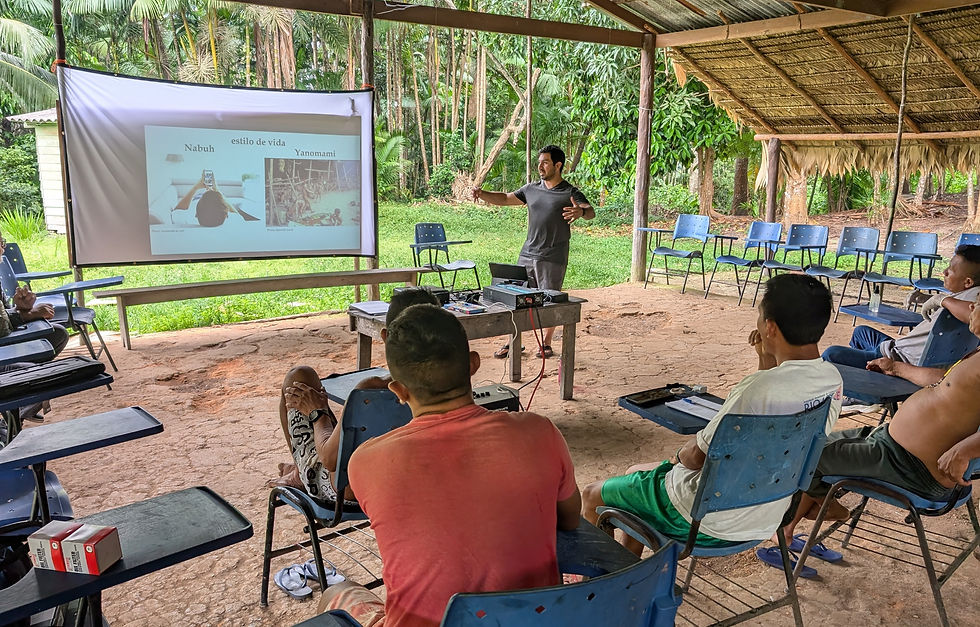
Soon afterward, my research journey would bring me back to my homeland in Yanomami territory in Venezuela. Later, it would take me to Yanomami communities in the Marauiá region of the Brazilian Amazon. Eventually, it would bring me to the University of Guelph in Ontario, where I began my PhD in Molecular and Cellular Biology and continued trying to understand the relationship between the human gut microbiome, environment, diet, and industrialization.

Along the way, I also began to understand that studying the Yanomami microbiome could never simply be about collecting samples and producing scientific papers.
The knowledge has to matter to the Yanomami people whose biology makes that research possible.
For us, microbiome research also raises questions about food, territory, environmental change, health, and the future. If scientists are learning something important about the Yanomami through their microbiomes, then Yanomami communities should also have the opportunity to understand that knowledge, discuss what it means, and decide how it may be useful to them. My training has since illuminated an incredible microbial world within the Yanomami, one intimately connected with diet, environment, history, and ways of living that remain deeply connected to the Amazon rainforest.
That realization has changed the way I think about science.
And I am now only weeks away from finishing my PhD.
One of the most important things I have learned is that this knowledge should not only belong to scientists and benefit only academia. It is important for Yanomami people to understand this microbial world too. They should know what researchers are discovering about their bodies, participate in interpreting what those discoveries mean, and determine how that knowledge can serve their communities.
And the deeper I have gone into this research, the harder it has become to separate questions about human health from questions about the environment.
The rainforest is central for Yanomami life. It shapes food, water, culture, ecology, microbial exposures, and countless relationships that we are only beginning to understand scientifically.

Protecting the rainforest therefore means protecting far more than trees.
It means protecting ways of life, knowledge, biological diversity, and perhaps even microbial worlds that science has only just begun to discover.
Back in 2019, as I was learning how to use a pipette and sequence DNA, I was about to embark on a journey that would bring science, family, identity, the Yanomami people, and the rainforest together in ways I could never have anticipated.
Continue Exploring:
To learn more about the Yanomami Foundation and support Yanomami communities, please visit www.yanomamifoundation.org
Watch our official trailer to WAYUMI. Coming out to Amazon Prime Video soon.