Further Reflections on Yanomami Microbiome Research, Reciprocity, and Ethical Collaboration


After sharing my recent public response, and after discussing these issues with colleagues and friends, I want to offer this follow-up as an additional resource for anyone trying to better understand the ethical questions surrounding Yanomami microbiome research.
My goal here is not to repeat every detail of the previous public statement, but to clarify several broader issues that emerged from the discussion: reciprocity, benefit-sharing, anthropology, language, research funding, Yanomami agency, and the responsibilities of microbiome researchers working with Indigenous communities.
Although some of these questions may resonate across disciplines, I am writing from my own position as a Yanomami person and microbiome scientist. My central concern is how microbiome research with the Yanomami can be conducted lawfully, ethically, reciprocally, and with accountability to the communities whose lives, knowledge, biological samples, language, and trust make this research possible.
Why microbiome research matters for the Yanomami
Microbiome science is advancing rapidly. Every year, researchers learn more about how gut microbes shape nutrition, immunity, metabolism, inflammation, and risks for chronic disease. But much of this knowledge comes from populations that are already overrepresented in biomedical research, especially industrialized societies. The benefits of those discoveries often return most directly to the populations whose data are included.
This reflects systemic inequities in benefit-sharing and access to knowledge, resources, and medicine. But from a microbiome science perspective, there is another issue as well: microbiome data from industrialized populations may not fully represent the microbiome of a Yanomami person. If researchers are going to draw conclusions about the links between microbes and human health, it is imperative that Indigenous populations are not excluded.
The Yanomami are underrepresented in this space. Their microbiome is more than scientific curiosity. It is part of their health, their diet, their relationship with the rainforest, and their future as they face increasing exposure to market foods, environmental disruption, infectious disease pressures, and outside institutions.
We know that changes in microbial diversity and composition are linked to the rise of chronic inflammatory diseases, metabolic disorders, and autoimmune conditions. The Yanomami are not somehow immune to these processes. As many communities undergo early shifts toward urbanization, including changes in diet, housing structures, sanitation, medication use, and exposure to market and ultra-processed foods, there is a deep concern that microbial diversity may be lost before its significance is fully understood.
From a microbiome science perspective, it is ethically important to study the Yanomami microbiome because health recommendations based only on industrialized populations may not adequately reflect Yanomami biology, diet, ecology, or lived reality. If the Yanomami are excluded from microbiome research, they may also be excluded from future scientific knowledge that could help them understand and protect their own health.
The ethical question, then, is not whether microbiome research should happen or not happen. The question is how it can happen in a way that respects Yanomami agency, follows the law, avoids exploitation, returns knowledge, builds capacity, and makes Yanomami people participants in the science rather than merely sources of samples.
The article did not begin with the current controversy
One point worth clarifying is that our paper, Toward a Yanomami Framework for Ethical Microbiome Research, was not written as a response to the current MPF inquiry in Brazil. Its origins came much earlier, through years of reflection, field experience, and collaboration among co-authors whose work with Yanomami communities spans decades.
Much of the ethical thinking that shaped the article emerged from work in the Upper Orinoco of Venezuela, where my mother’s community is located and where I first began returning as an adult to reconnect with my Yanomami family. More recently, my work in Brazil deepened my sense that many of the same ethical questions were present across national contexts: consent, communication, reciprocity, capacity-building, research benefits, and the challenge of ensuring that Yanomami people are not treated simply as sources of data. The relationships I built with the Marauiá communities became an important part of my thinking, but they were not the origin or the sole basis of the framework.
Yanomami communities are not all the same. They are diverse, historically situated, and differently positioned in relation to outside institutions, missions, researchers, health systems, and state agencies. What is true in one region cannot automatically be assumed to represent all Yanomami communities.
This matters because the Venezuelan Yanomami are often less visible in international discussions, even though their experiences were central to the development of our framework.
Reciprocity is not payment for consent
One concern raised in recent discussion is that benefit-sharing could become dangerous if it turns ethics into a question of money. In other words, if the best-funded researchers are seen as the most ethical, then research ethics becomes “priced.” This would disadvantage researchers from the Global South, less-funded disciplines, and local scholars who may have deep knowledge but fewer resources.
I agree with this concern.
Ethical research cannot be measured by the amount of money, technology, or material support a researcher can provide. Reciprocity should never become payment for consent. Community support should never be offered as a reward for providing samples or participating in research.
That is an ethical line that must remain clear.
But this is not what we mean by reciprocity.
Our concern is that research often creates immediate benefits for researchers and institutions: publications, grants, degrees, salaries, promotions, tenure, professional recognition, and future funding. Meanwhile, the communities whose biological samples, knowledge, labor, trust, and logistical support make the research possible may receive little in return.
That imbalance is not only a biomedical problem. It exists across disciplines. Anthropological research can also transform Yanomami language, stories, cultural knowledge, political struggles, ecological knowledge, and relationships into publications, degrees, grants, salaries, tenure, and professional authority. This does not mean anthropology is the same as microbiome research. Biological samples create specific ethical risks. But all research with the Yanomami depends, in some way, on Yanomami knowledge, trust, time, relationships, and interpretation.
So the question is not only whether biological samples are collected. The question is whether Yanomami participation in any research field leads to fair recognition, accountability, and opportunities for Yanomami people themselves.
Ethical collaboration has real costs
When we argue that research budgets should include support for community-defined priorities, we are not saying that money equals ethics. We are saying that ethical collaboration has real costs.
Translation costs money. Return visits cost money. Community meetings cost money. Educational materials cost money. Communication systems cost money. Training opportunities cost money. Laboratory visits, local personnel, field assistants, interpreters, and community-facing reports all require resources.
From a microbiome research perspective, if universities can budget for equipment, sequencing, travel, salaries, publication fees, overhead, and conferences, then they can also allocate a proportionally modest amount to support the Yanomami research colleagues and communities who make the research possible.
Just as importantly, these resources help make the research process more visible and understandable to the communities involved. Many Yanomami communities are not given a clear view of the grant cycles, university incentives, authorship systems, budgets, salaries, or professional rewards that structure academic research. Ethical collaboration should not require Yanomami communities to navigate these fragmented systems alone, especially when those systems are often difficult even for researchers themselves to understand.
Treating these costs as legitimate research expenses is not the same as pricing ethics. It is a way of refusing to let institutions benefit from Indigenous participation while leaving communities to absorb the burdens of collaboration.
Anthropology is critical to microbiome research
Although I write as a microbiome scientist, not as an anthropologist, I do not believe microbiome research can be separated from anthropology or other disciplines. Microbiome research is transdisciplinary by nature. I often say that the extraordinary diversity of the Yanomami gut microbiome reflects the Yanomami diet. But the Yanomami diet is not simply a list of foods. It reflects a much larger relationship with the rainforest: physical, psychological, emotional, social, and spiritual dimensions of life.
To understand the microbiome comprehensively, we must also take seriously language, culture, kinship systems, ecological knowledge, food practices, mobility, social structures, contact history, health care access, market foods, missionization, and political pressures. Anthropology is therefore not peripheral to ethical Yanomami microbiome research. It is critical. Without anthropological insight, microbiome research risks reducing a living, relational system to biological data alone.
At the same time, I believe microbiome scientists and anthropologists need to be in honest conversation about the ways all academic fields can benefit from Yanomami knowledge, time, relationships, and trust. That does not mean all disciplines raise the same ethical issues. Biological samples create specific responsibilities. But no field is completely outside the question of reciprocity.
My own positionality
I also recognize that my own position is complex.
I am Yanomami. My mother is Yanomami, my family lives in Yanomami territory, and my identity is rooted in kinship, memory, and responsibility. But I am also a scientist trained in North America. I live in Canada. I have access to universities, networks, laboratories, foundations, and funding pathways that most Yanomami people do not. That creates obligations.
It means I must be especially careful about how my presence is understood and how support, research, kinship, and institutional power may be perceived in the field.
At the same time, I hope we can be careful not to treat Indigenous access to science, education, or international networks as something that diminishes Indigenous agency. My goal is not to speak over Yanomami communities. My goal is to use the access I have to help create pathways for more Yanomami people to understand, question, shape, and eventually lead research themselves.
Language must be central to ethics
One critique I found especially valuable concerns Indigenous languages.
Translation is not merely a technical matter. It is central to ethics.
Words such as consent, sample, data, payment, reciprocity, ownership, benefit, and responsibility do not move easily across languages or worlds. Researchers should not expect Yanomami communities to carry the full burden of interpreting our concepts, methods, and institutions.
We must also do the work of learning from Yanomami language, categories, and ethical understandings.
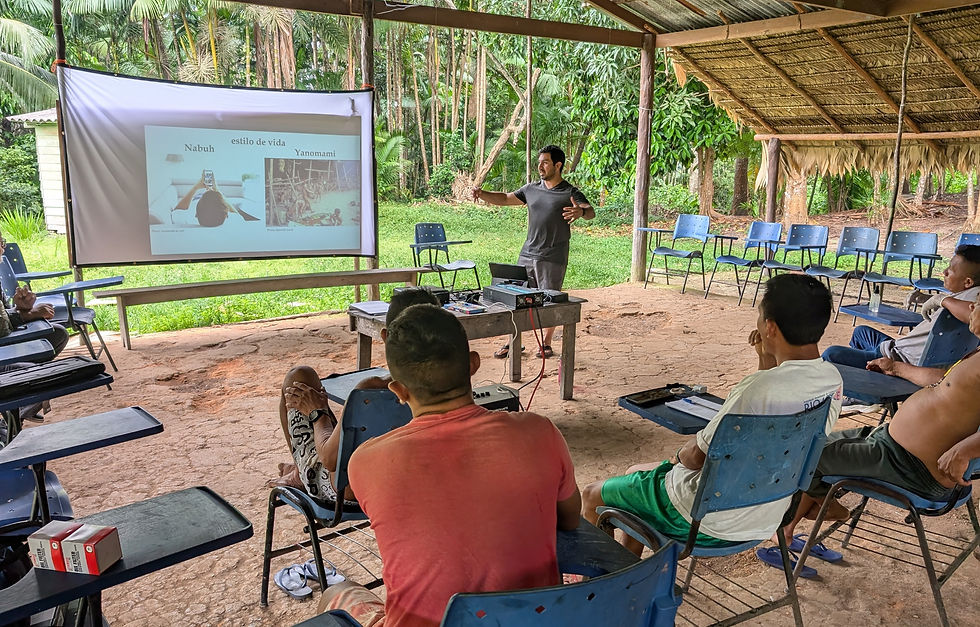
This is why my current work with Wikitongues matters to me. As part of the 2025 Wikitongues Fellowship, I am working toward developing a Yanomami Microbiome Guidebook that will translate and narrate microbiome concepts, such as microbiota, bacteria, dietary fiber, and ultra-processed foods, in Yanomami, while connecting scientific education with language preservation and biocultural knowledge.
The project is designed to create multilingual resources, including Yanomami-Spanish and Yanomami-Portuguese materials, as well as short educational videos in the Yanomami language. The goal is not simply to explain microbiome science to Yanomami communities in an outside language. The goal is to help make microbiome research understandable through Yanomami language, Yanomami categories, and Yanomami ethical priorities.
This is part of the ethical framework itself.
If Yanomami communities are asked to consider microbiome research, then microbiome science must become explainable in Yanomami terms, through Yanomami language, and from a Yanomami perspective. Otherwise, the burden of translation remains uneven: researchers ask communities to understand our scientific worlds, while we do too little to enter theirs.
If our framework continues to develop, language must be made more explicit. Not only as a tool for communication, but as a foundation for understanding how ethical relationships are built, misunderstood, repaired, and sustained.
I am very excited about this project, and its success will require the kind of interdisciplinary collaboration I believe ethical microbiome research needs: anthropologists, microbiome scientists, public health researchers, linguists, Yanomami knowledge holders, and community leaders working together.
Moving forward
Our short perspective article is not the final word on ethical microbiome research with the Yanomami.
I see it as one contribution to a larger conversation that must include anthropologists, microbiome scientists, Brazilian and Venezuelan institutions, Indigenous leaders, health workers, linguists, local researchers, and most importantly, Yanomami communities themselves.
If this discussion helps clarify the difference between reciprocity and inducement, then it is useful.
If it helps show that extractive research can occur across disciplines, then it is useful.
If it helps place Indigenous languages more centrally in research ethics, then it is useful.
If it reminds us that legal protections and Yanomami agency must work together, not against each other, then it is useful.
And if it helps us build a future where Yanomami people are not only studied, but included, trained, credited, respected, and empowered to lead, then these difficult exchanges will have been worth having.
Although I believe the MPF inquiry arose from serious misunderstandings and an unfair characterization of my work, I also recognize that this moment has brought greater visibility to urgent questions about ethical microbiome research with the Yanomami. I truly believe that many of us are trying to protect the same things: the dignity and agency of the Yanomami people, the well-being of my Yanomami family, and the future of their rainforest home.